Seneca Or Carolina – Which Style Metal Barn Is Best For Your Farm?
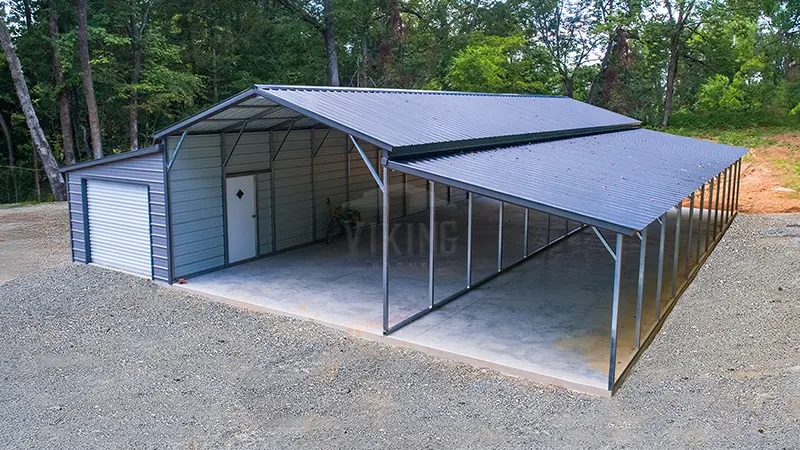
Starting a new farm project?
Farm and ranch owners are increasingly choosing metal prefab barns because of their durability, cost-effectiveness, low maintenance, durable flooring and insulation needs compared to a traditional wooden structure. But picking the right barn design is not just about looks; it affects how you can use your space, store items, and shelter animals.
Among all, the two most popular steel farm barn designs are – the seneca steel barn and the Carolina barn. Both have strong steel framing and practical layout, but are built differently to suit multiple farm or ranch needs. So, how do you decide which one to choose?
This guide will break down the key differences between Seneca and Carolina barns and help you choose the best fit for your farm, ranch, or agribusiness.
The Seneca Style Metal Farm Barn
What It Is: A Seneca barn features an A-frame or gable roof design with two slopes that meet at a single peak. This design creates a uniform and continuous roofline across the entire barn structure.
That’s why it is also known as a continuous roof barn. This type of barn offers open interior space without any columns to store large equipment, machinery, and for a free-flowing space.
Pros:
The key features and benefits of a Seneca farm barn are –
- Its elevated center section gives ample space and headroom for storing large equipment, feed, and farm supplies.
- The uniform roofline gives the classic aesthetics of a clean, traditional barn look that many farmers would love.
- The continuous sloped roof provides excellent water runoff, i.e., it helps shed rain and snow efficiently, preventing leaks and reducing chances of rusting.
- The Seneca-style barn has structural simplicity and can be easily built and enclosed, depending on need.
- A continuous roof design distributes the weight evenly and is ideal for handling heavy snow loads.
- For small to medium sizes (30 to 48 ft. wide), a Seneca-style barn will need fewer materials and labor costs, but for larger ones, you may need to add extra anchors, purlins, and braces for support.
Cons:
Some considerations and potential drawbacks of a Seneca-style barn are –
- One of the downsides of a continuous roof barn is that it has less interior height in lean-tos since the roof slopes down on the sides.
- It might be challenging to create a proper ventilation system, especially in areas that are tightly packed and in warmer climates.
- It is difficult to add extensions to a Seneca-style barn while maintaining the continuous roofline.
- You may have to add structural supports to the steel frames to create a large-span interior in a Seneca-design barn.
When To Choose A Seneca Steel Barn:
Choose a Seneca steel frame barn if –
- If you prefer a traditional barn, look for a smooth, continuous roofline.
- If you need a multi-purpose space for livestock (small herd size), storage, or a workshop.
- If you live in snow-prone areas.
- If you want a simple construction that is cost-effective for a medium-sized barn.
The Carolina Style Metal Barn
What It Is: A Carolina barn features a ‘step-down’ or ‘offset’ roof design with multiple roof levels. The central part is taller, while the side lean-tos have lower, separate rooflines that ‘step down’ from the main roof.
This style of barn has many names, like monitor barn, step-down barn, raised center aisle barn, or simply raised barn. The central unit is taller than its side wings and can be fully open, partially enclosed, or fully enclosed as per a farm’s needs.
Pros:
Key features and benefits of a Carolina-style barn are –
- The step-down design gives extra vertical clearance in the side sections, making it ideal for taller equipment, hay storage, and for including large animal stalls.
- Its raised center part allows for roof vents, cupolas, and ridge vents that improve airflow, offering superior ventilation, especially in hot climate regions.
- You can add higher windows in the central section to get more daylight, improving natural lighting inside the barn and reducing the need for artificial lighting during the daytime.
- Its symmetrical roofing structure makes it stable against strong winds. You can choose a vertical roofing style to further improve its wind resistance.
- A Carolina steel barn has distinct ridge lines, which give it a contemporary, industrial aesthetic, making them a versatile building that can be used beyond farming.
- Its side sections have separate rooflines, so it is easy to expand, as adding extra space later will be simpler.
Cons:
Considerations and potential drawbacks of a Carolina-style barn are –
- The initial multi-level roof design requires additional framing and engineering, making it slightly harder to build.
- More use of materials and complex design can add to your budget and increase labor costs during the initial construction stage.
- Its roof ‘valley’ can trap water or snow, so it requires proper drainage to avoid rusting and leaks.
- You can’t choose a regular roofing style with a Carolina-designed farm building.
- It may give a less rustic feel compared to a Seneca-style steel barn.
When To Choose A Carolina Barn:
Choose a Carolina steel barn if –
- If you need maximum height clearance in the lean-tos for tall vehicles or livestock.
- If you live in a hot climate where strong ventilation and air circulation are essential.
- If natural lighting is your priority for reducing artificial lighting and energy bills.
- If you plan to expand the metal farm barn in the future.
- If you want a sleek, industrial-style barn.
Seneca Vs. Carolina – Which One Should You Choose?
Below, we provide a quick glimpse of both Seneca and Carolina–style barns and compare them side-by-side so you can easily choose one that suits your farm, ranch, or agribusiness needs.
| Features | Seneca Style Steel Barn | Carolina Style Steel Barn |
| Roof Design
|
Continuous A-frame | Step-down |
| Available Roof Styles
|
● Regular
● Boxed eave/ horizontal ● Vertical
|
● Boxed eave/ horizontal
● Vertical |
| Interior Height
|
Lower in lean-tos | Higher in lean-tos |
| Ventilation
|
Requires planning | Built-in airflow advantage |
| Expansion
|
More complex | Easier to add sections |
| Cost
|
Generally lower | Can be higher due to complexity |
| Best For | ● Snow-prone areas
● Traditional aesthetic |
● Tall equipment
● Hot climate ● Windy regions ● Modern look |
Key Considerations For Your Farm When Choosing A Barn Design
Before deciding between a Seneca–style and a Carolina-style prefab barn, consider the following –
- Budget – While both are cost-effective, Carolina Barn may be slightly higher in price due to extra raw materials.
- Farm Needs – What is the primary use of your steel prefab barn – sheltering livestock, for a workshop, or storing tools and equipment?
- Local Climate – Heavy snow? Choose Seneca. Hot weather? Carolina is better.
- Aesthetics – For a classic farm building look, choose Seneca, while for a modern building, pick Carolina.
- Future Expansion – If you plan on adding extra space in the future, a Carolina prefab barn will make modifications easier.
- Site Specific Factors – Does your land have proper drainage? Will the building be exposed to wind or obstacles?
- Foundation Needs – What type of foundation do you prefer? Concrete slab or gravel base. Consider the local soil types, their stability, and anchoring.
- Permits And Regulations – Check your local zoning laws, building permits, and environmental restrictions, along with wind and storm ratings, before buying a metal prefab building for agricultural use.
Ready To Upgrade Your Farm? Explore Your Metal Barn Options Today!
Choosing the right metal prefab barn is a big decision that impacts your farm’s efficiency and productivity in the long run. A Seneca barn provides a modern, open design for sheltering large equipment, while a Carolina barn separates spaces for livestock, storage, and multi-purpose use.
But, before you make a choice, ask yourself:
- What will be the main purpose of the barn?
- Will you need separate sections or one large space?
- How much ventilation and natural light will you need?
With a well-planned barn, your farm will run smoothly for years to come. Whether you choose Seneca or Carolina, making the right choice starts with choosing the right metal barn dealer who provides high-quality materials and excellent craftsmanship so that your steel farm barn lasts for years and gives you a better long-term value.