How Small eCommerce Brands Can Compete With Big Retailers Using Better Shopping Experiences?
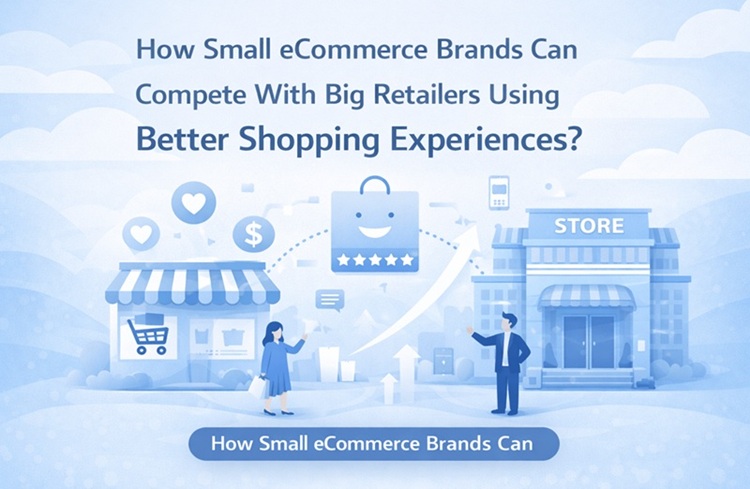
A Huge Competitive Advantage: A Good Shopping Experience
It can be observed that, more and more over the last few years, the gap between small online stores and large retail brands has become a lot about the shopping experience itself and less about the availability of a product. That does not necessarily mean that product availability isn’t important; rather, it is a key factor on its own. But store owners often underestimate the importance of a good shopping experience, being too indulged in the product availability aspect.
Big retailers usually win on scale, pricing power, and logistics. But we have noticed something interesting, they do not always win on experience. The good thing about having a smaller eCommerce brand is that you have more control over the look and feel of your store. Because a small store allows you to test new ideas, move around faster, and create more personalized interactions without having to worry about factors such as approvals or other complex systems.
So in short, a smaller store has more flexibility and a wider range of opportunities to test where it truly sits. We know now that the modern customer is not only comparing prices anymore, but they are also comparing how easy, enjoyable, and smooth your store’s buying process feels across different stores.
Interactive and Personalized Product Pages
One of the clearest differences between small stores and big retailers is how products are presented. Retailers with larger organizations have to rely on more standard templates because they hold thousands of products on average. Smaller brands, however, deal with fewer products comparatively, which makes it much easier to manage.
For a larger brand, what might take a whole team to shift around and modify their products, for a smaller brand, might not be a job for more than one individual at most. The keyword here is control to customers, and when you give them more control over product selection, you will see more engagement with your store as well. Hence, the importance of customization!
Some practical ways to improve product interaction:
- Allow customers to personalize products before purchase
- Offer selectable upgrades or add ons on product pages
- Use clear visual swatches instead of plain dropdowns
- Show real time price changes based on selection
Sometimes you can use plugins such as the WooCommerce product addons which may be universally beneficial for all kinds of online store, letting you attach extra options directly to your products without having to create extra listings. You are basically handling multiple products with just a few clicks. That is the basic purpose of plugins.
Then there are other plugins such as product options that support this very approach, allowing you to apply conditional fields, image-based selections, and pricing structures that are unique and dynamic, letting small stores create a smooth shopping journey.
Store Navigation and Product Discovery
Big retailers usually have advanced search systems and recommendation engines. Small stores cannot always match that level of infrastructure, but they can still improve how customers discover products in simpler ways.
We have noticed that confusion during browsing is one of the biggest reasons customers leave smaller stores. If users cannot quickly find what they need, they simply move on.
Some practical improvements include:
- Clear category structure with minimal overlap
- Smart filtering options for size, type, or use case
- Featured collections for best sellers or seasonal products
- Internal linking between related products
Plugins like advanced product filters, search optimization tools, and WooCommerce catalog enhancers can make a noticeable difference here. Even basic improvements in filtering can make a small store feel more professional and easier to use.
We think the goal is not to match Amazon’s level of complexity, but to reduce friction as much as possible so customers never feel lost.
Smarter Bundles and Product Combinations
Another area where smaller brands can compete against larger-scale brands is in bundling. Most large-scale organizations rely on generic bundle strategies, whereas smaller stores have the advantage of being more intentional and curated with their combinations. In simple terms, customers respond better to bundles that feel put together more thoughtfully rather than randomly.
Some effective bundle strategies include:
- Starter kits for beginners
- Seasonal or themed product bundles
- “Frequently bought together” style combinations
- Gift sets with flexible product selection
WooCommerce plugins that support mix and match or bundle building can help create these experiences. When customers are allowed to build their own combinations, engagement increases because they feel more involved in the purchase.
We think this approach works especially well for gift-based or lifestyle products where personal preference matters a lot.
Personalization and Checkout Experience for Growth Leveling
One of the most underestimated areas in eCommerce is the checkout journey itself. Big retailers optimize it heavily, but small stores actually have more freedom to experiment here.
We have noticed that even small improvements in checkout experience can directly impact conversion rates.
Some useful enhancements include:
- Guest checkout options for faster purchases
- Custom thank you pages with product suggestions
- Personalized order messages or confirmations
- Post purchase upsell opportunities
Plugins for custom checkout fields, thank you page customization, and post purchase funnels can help replicate some of the techniques larger retailers use, but in a much more flexible way.
We think the post purchase moment is especially valuable because the customer is already engaged, and even a simple suggestion can lead to another sale.
Building Trust Through Better Product Communication
Large retailers often win on trust simply because of brand recognition. Small brands need to build that trust through clarity and communication instead.
We have observed that customers are more likely to complete a purchase when they feel fully informed.
Some ways to improve trust include:
- Clear product descriptions without unnecessary complexity
- Real images instead of overly polished stock visuals
- Transparent pricing with no hidden costs
- Visible reviews or customer feedback
Even small details like consistent product formatting or better structured information can make a store feel more reliable.
We think trust is not built in one moment, it is built across every small interaction a customer has with the store.
Leveraging Tools and Plugins
A big misconception that smaller eCommerce brands assume is that they need enterprise systems, which usually apply to larger organizations, to compete against them. However, that is not always the case; if not, for the majority of the time. More notably successful small-scale stores are those that rely on a small set of well-chosen tools and plugins rather than going in an overly complex direction.
Some useful plugin categories include:
- Product customization tools
- Bundle and mix match builders
- Advanced filtering and search systems
- Checkout and post purchase optimization tools
The key is not to add everything at once, but to choose tools that directly improve the customer experience without slowing down the store.
We think simplicity often performs better than complexity when it comes to small and mid sized stores.
Conclusion
Competing with large retailers is not about copying everything they do. It is about identifying areas where small brands actually have an advantage and using that advantage effectively.
Our research and observations have brought us to the conclusion that experience, personalization, and flexibility matter more to customers than just the scale of your products. Smaller eCommerce brands can use this to their advantage and focus on how their products are presented instead of just “where”.
When combined with the right plugins, such as options like the WooCommerce product addons, smarter bundles, and better checkout flows, small stores can create shopping experiences that feel more personal and more engaging than what large retailers typically offer.
We think the real opportunity lies in not trying to become bigger, but in becoming more intentional with every part of the shopping experience.f