From the Mine to the Museum How Opalised Fossils Reach Science
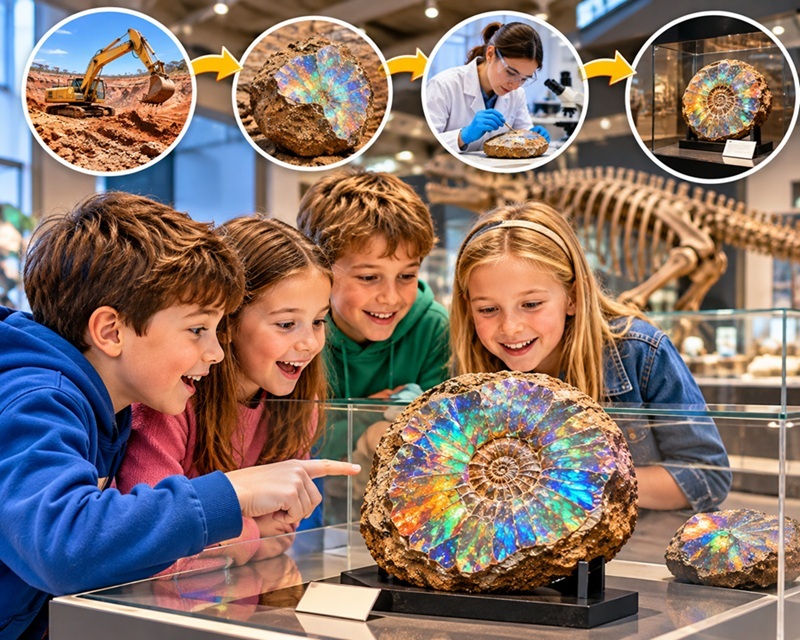
Have you ever wondered what happens when ancient creatures meet precious gemstones? Can you imagine holding a dinosaur bone that’s been transformed into shimmering opal? What makes these extraordinary specimens so captivating that scientists and collectors alike will travel to the Australian outback just to glimpse them?
Opalised fossils represent one of nature’s most remarkable accidents. These aren’t just pretty stones—they’re windows into prehistoric Australia, preserved in a way that’s found almost nowhere else on Earth. When ancient bones, shells, and even pine cones become replaced by opal, they create something truly extraordinary: a perfect marriage of palaeontology and gemology.
In this article, we’ll explore the incredible journey these specimens take from dusty mine shafts to gleaming museum displays. You’ll discover how they form, who finds them, and the careful scientific processes that unlock their secrets. Whether you’re a fossil enthusiast, an opal lover, or simply curious about Australia’s unique geological heritage, there’s something fascinating waiting for you here.
What Are Opalised Fossils and How Do They Form?
The Science Behind Opalisation
Opalisation is essentially nature’s version of a slow-motion magic trick. It begins when an ancient creature dies and becomes buried in sediment. Over millions of years, silica-rich water seeps through the ground and gradually replaces the original organic material. What’s left behind is a perfect replica of the original fossil—but made entirely of precious opal.
This process takes an extraordinarily long time. We’re talking tens of millions of years for the transformation to complete. The silica solution fills every tiny cavity and crack, preserving incredible detail. Some opalised fossils even show individual teeth marks or delicate bone structures.
Why Are Opalised Fossils Only Found in Certain Places?
The conditions required for opalisation are incredibly specific. You need the right type of sediment, the correct chemical environment, and millions of years of stable geological conditions. Australia’s inland sea, which existed during the Cretaceous period (roughly 100 million years ago), created the perfect recipe.
When this ancient sea retreated, it left behind vast deposits of silica-rich sediment. The weathering of these deposits over millions of years released silica into groundwater, which then infiltrated any buried organic material. It’s a geological lottery that Australia happened to win.
Lightning Ridge and Coober Pedy: Australia’s Opalised Fossil Hotspots
Lightning Ridge in New South Wales is arguably the world capital of opalised fossils. This dusty outback town has produced some of the most significant specimens ever discovered, including the famous “Eric” the pliosaur. The black opal found here creates stunning contrast with the fossilised material.
Coober Pedy in South Australia is another major hotspot. While perhaps better known for its precious white opal, this underground town has also yielded remarkable opalised marine creatures. Both locations continue to surprise scientists with new discoveries, making them essential destinations for palaeontological research.
How Are Opalised Fossils Discovered?
The Role of Opal Miners in Fossil Discovery
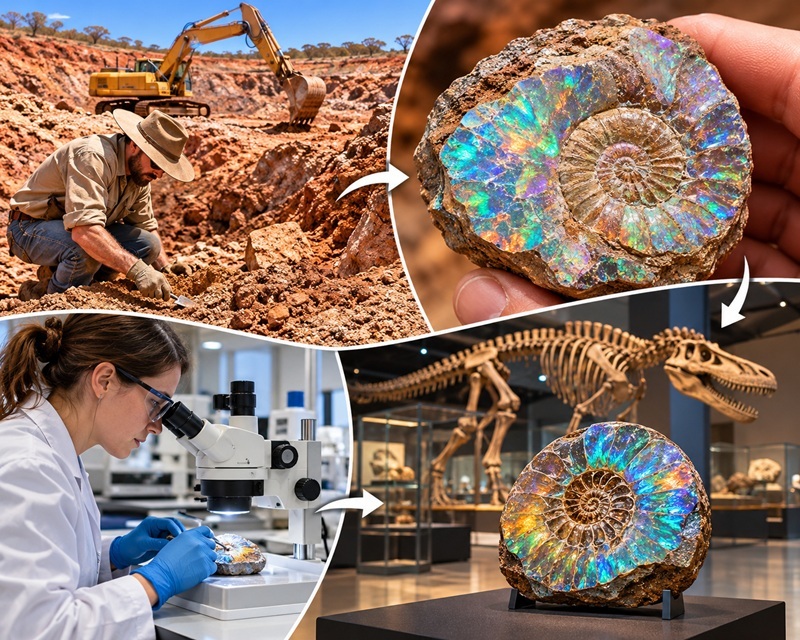
Here’s something that might surprise you: most opalised fossils aren’t found by scientists at all. They’re discovered by hardworking opal miners who are simply trying to make a living. These miners spend countless hours underground, carefully extracting opal from ancient clay deposits.
Mining for opal is tough work. Miners use picks, jackhammers, and sometimes explosives to break through rock. It’s during this process that they occasionally stumble upon something unexpected—a flash of iridescent colour that reveals itself to be an ancient tooth or bone.
What Happens When a Miner Finds an Opalised Fossil?
When a miner spots something unusual, decisions need to be made quickly. Some fossils are obvious—a perfectly formed shell or a recognisable bone. Others are more ambiguous and require expert evaluation. Experienced miners have learned to pause and assess before proceeding.
Many miners have developed relationships with local museums and universities. They know that certain specimens might be scientifically significant, even if they’re not commercially valuable. This informal network has proven essential for science, ensuring that important discoveries don’t simply disappear into private collections.
Are Opalised Fossils Worth More Than Regular Opals?
This is where things get complicated. From a pure gemstone perspective, the opal quality determines value—colour play, brightness, and size all matter. However, scientific significance adds another dimension entirely. A fragmentary fossil made of poor-quality opal might be priceless to palaeontology while worth little on the gem market.
Some specimens sit in a fascinating middle ground. They’re beautiful enough to command high prices as gemstones but significant enough to warrant scientific study. These pieces often spark difficult conversations about commercial versus scientific value.
From Rough Ground to Careful Hands: The Extraction Process
How Do You Safely Remove an Opalised Fossil from Rock?
Extracting an opalised fossil requires patience and precision. Unlike regular fossils, opalised specimens are often quite fragile. The opal can crack or shatter if handled roughly, destroying both the scientific and commercial value in an instant.
The surrounding rock, known as matrix, is typically removed in stages. Workers start far away from the fossil and gradually work closer, using increasingly delicate tools. Some specimens remain partially embedded in their matrix to provide additional support and context.
Tools and Techniques Used in the Field
Miners and preparators use an array of tools depending on the situation. Pneumatic air scribes—essentially tiny jackhammers—can remove rock quickly but must be used carefully near the fossil. Dental picks and brushes handle the most delicate work, sometimes taking hours to clear a few millimetres of material.
Modern technology has also entered the picture. Some collectors now use micro-sandblasters to carefully remove rock. Others employ consolidants—special glues that penetrate and strengthen fragile opal before extraction begins.
Common Challenges During Extraction
Cracks present a constant worry. Opal is inherently brittle, and existing fractures can suddenly propagate during extraction. Temperature changes between the cool underground environment and the hot surface can also cause stress fractures, making timing and handling critical.
Water content poses another challenge. Opal contains significant amounts of moisture, and rapid drying can cause crazing—a network of tiny cracks that destroys the gem’s beauty. Skilled handlers know to wrap specimens in damp cloth and allow them to dry slowly over weeks or months.
Can You Sell Opalised Fossils in Australia?
Legal Considerations and Heritage Protection Laws
Australian law treats opalised fossils differently depending on their significance. While individual miners technically own what they extract from their claims, there are restrictions on exporting nationally significant specimens. The Protection of Movable Cultural Heritage Act can prevent particularly important fossils from leaving the country.
State laws also come into play. Some specimens fall under heritage protection frameworks that require notification to authorities. Navigating these regulations can be complex, and miners often work closely with museums to ensure compliance.
How Do Fossils End Up in Private vs. Public Collections?
The pathway a fossil takes depends on many factors. Commercially valuable specimens with limited scientific significance often enter the private market, selling through dealers and auction houses. More significant pieces may be purchased or donated to institutions.
Museum acquisition is rarely straightforward. Budget constraints mean institutions can’t simply buy every important specimen. Instead, they rely on a combination of purchases, donations, and negotiated agreements. Some miners have donated specimens in exchange for naming rights or other recognition.
The Journey to the Laboratory: Scientific Preparation
Cleaning and Stabilising Opalised Specimens
Once a fossil reaches a laboratory, careful cleaning begins. This process removes any remaining matrix while preserving the delicate opal surface. Preparators work under magnification, sometimes spending hundreds of hours on a single specimen.
Stabilisation ensures the fossil’s long-term survival. Cracks are filled with specialised resins, and fragile areas receive additional support. The goal is to preserve the specimen for centuries while maintaining its visual appeal and scientific integrity.
How Do Scientists Study Opalised Fossils Without Damaging Them?
Modern imaging technology has revolutionised the study of opalised fossils. CT scanning allows researchers to see internal structures without cutting or drilling. These non-invasive techniques reveal details that would otherwise remain hidden forever.
Three-dimensional printing takes this further. Scientists can create exact replicas from scan data, allowing hands-on study without risking the original. These copies also enable research by scientists worldwide who cannot travel to see the actual specimens.
Conclusion
The journey from mine to museum represents an extraordinary collaboration between miners, scientists, and institutions. Each opalised fossil that reaches public display has passed through many careful hands, each person contributing to its preservation and understanding.
These specimens are irreplaceable. Once destroyed or lost, an opalised fossil cannot be recreated. This reality places enormous responsibility on everyone involved in their discovery, extraction, and conservation. Getting it right matters enormously.
Australia’s opalised fossils represent a unique intersection of natural beauty and scientific importance. They tell stories of ancient creatures and lost worlds while dazzling viewers with their gemstone brilliance. Whether you encounter one in a museum case or simply read about these remarkable specimens, you’re connecting with something truly special—a message in opal from the deep past, preserved for our wonder and learning.